War Between Israel and Judah (925-886BC)
Ref: 1 Kings 14-15, 2 Chronicles 12-16
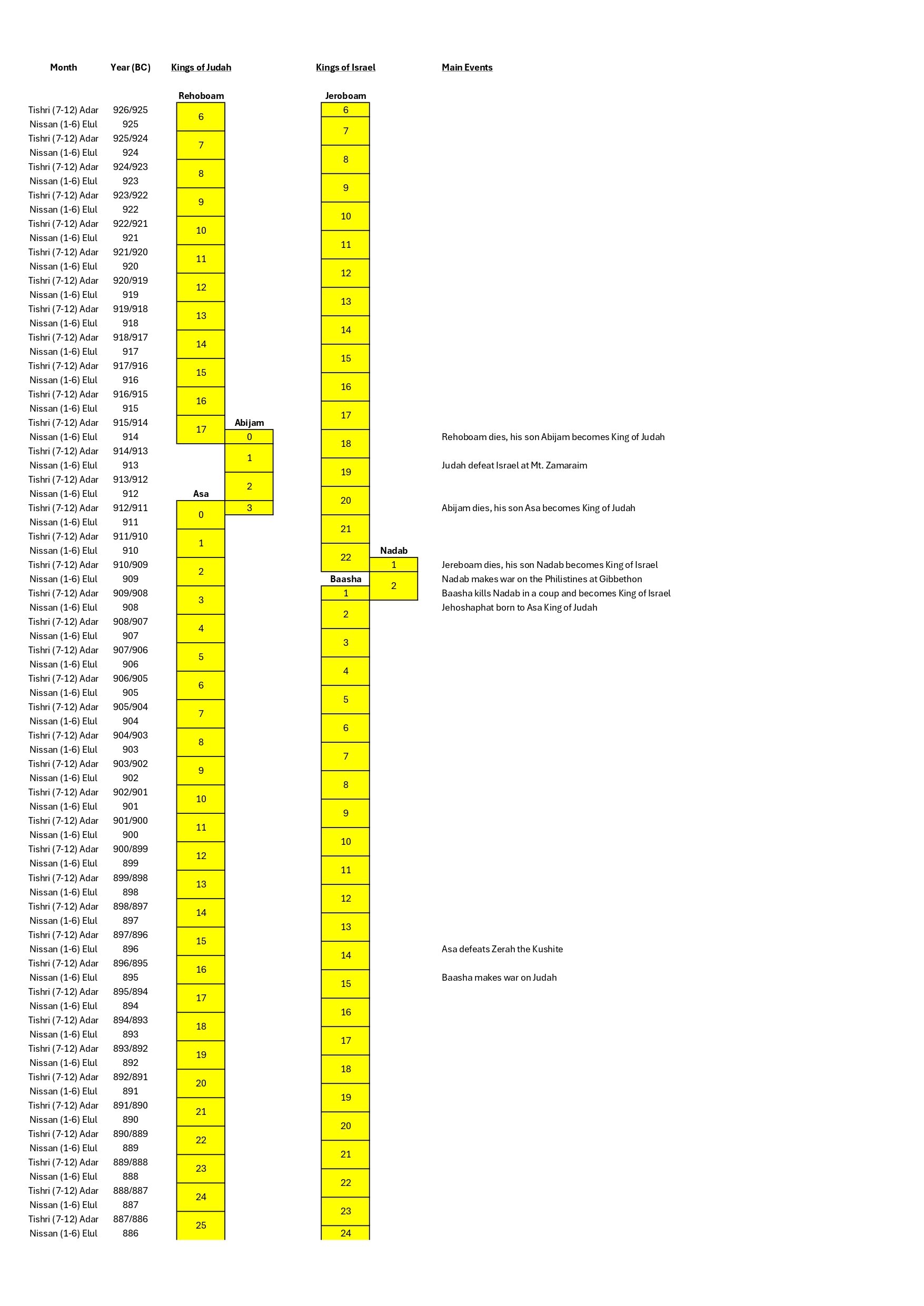
Sometime after the death of Pharoah Shoshenq I, there was war between Jeroboam King of Israel and Rehoboam King of Judah, although this was likely limited to border conflicts and skirmishes. In 914BC Rehoboam died and was succeeded by his son Abijam as King of Judah. Abijam inherited the conflict with Jeroboam which culminated in a major battle around 913BC at Mount Zemaraim. According to Chronicles it was 800,000 men of Israel vs Abijam’s 400,000. This was a final showdown. The LORD gave Judah the victory with 500,000 men of Israel slain. Jeroboam was heavily defeated and lost the southern cities of Bethel, Jeshanah & Ephron.

Following the battle Jeroboam was subdued and it seems his dynasty no longer posed a threat to Judah. Abijam however in an attempt to sure up his security, appears to have made a treaty with Tabrimmon King of Syria (2 kings 15:18). Abijam reign didn’t last long and after 3 years he died somewhere after Tishri 912 and before Nissan 911BC. Asa his son then succeeded him as King of Judah which enjoyed peace for 10 years.
Sometime after Tishri 910 and before Nissan 909BC Jeroboam died having reigned 22 years over Israel. At the time of his death Jeroboam was livening in Tirzah which would be the royal capital until the time of Ahab. Jeroboam was succeeded by his son Nadab as king of Israel. Nadab had a short reign (910/909-909/908BC) but in his time the army had been built back up. He made war against the Philistines encamping against them at Gibbethon around 909BC. Sometime before Nissan of 908BC Baasha conspired against Nadab and killed him at Gibbethon. Baasha then took the throne and proceeded to kill everyone from the house of Jeroboam totally destroying the former dynasty. Baasha strengthened his position and later entered into a treaty with Ben-Hadad King of Syria to secure peace on his border. Meanwhile in Judah King Asa’s son and heir Jehoshaphat was born in 908BC. In the early part of his reign Asa brought about religious reform removing the altars, high places and idols from the land. Seeking to undo the idolatry that occurred under his fathers he commanded the people to seek the LORD and to observe the Law of Moses. Asa also embarked on many building projects building up fortified cities whilst the land had peace.
In the 15th year of Asa’s reign (896BC) Zerah the Kushite invaded Judah with a large army. Zerah was potentially a Kushite commander under Pharaoh Osorkon I of Egypt (922-886BC). Asa went out with his army and met him in the Valley of Zephathah at Mareshah. The LORD struck the army of Zerah and the people fled. The army of Judah pursued them to Gerar where they were overcome. Judah went on to plunder many the surrounding Philistine cities and returned with great spoil. (With the change of power in Israel and the resurgence of Judah, Egypt’s control of the Levant had been eroded, although they may still have exercised limited control over Philistia)
The following year (895BC) Baasha made war on Judah. It is likely at this time he recaptured the cities taken by Abijam before then invading Judah and capturing Geba and Ramah. Having taken Ramah he began fortifying it against Judah and tightly controlling the border. Asa’s response was one of fear. Taking silver and gold from the temple and the palace he sent it to Ben-Hadad King of Syria to enter into a treaty and request military aid. Ben-Hadad proceeded to invade from the north causing Baasha to abandon his campaign against Judah. Ben-Hadad attacked Ijon, Dan, Abel Beth Maachah, and all Chinneroth, with all the land of Naphtali. It is unclear whether he held onto these or whether Baasha was able to repel him. This however enabled Asa to enter into the abandoned Ramah and taking the building materials build up Geba and Mizpah (now back in Judah’s hands). An interesting sidenote, but at this time we’re told that Asa had made a pit in Mizpah for fear of Baasha king of Israel (Jeremiah 41:9). This was likely a part of his defensive fortifications to sure up the border against a further attack from Israel. Following Asa’s victory the LORD sent Hanani the prophet to rebuke him for depending on the king of Syria. Asa was enraged at this and put Hanani in prison. This also marks a turning point in his reign as he then oppressed some of the people.