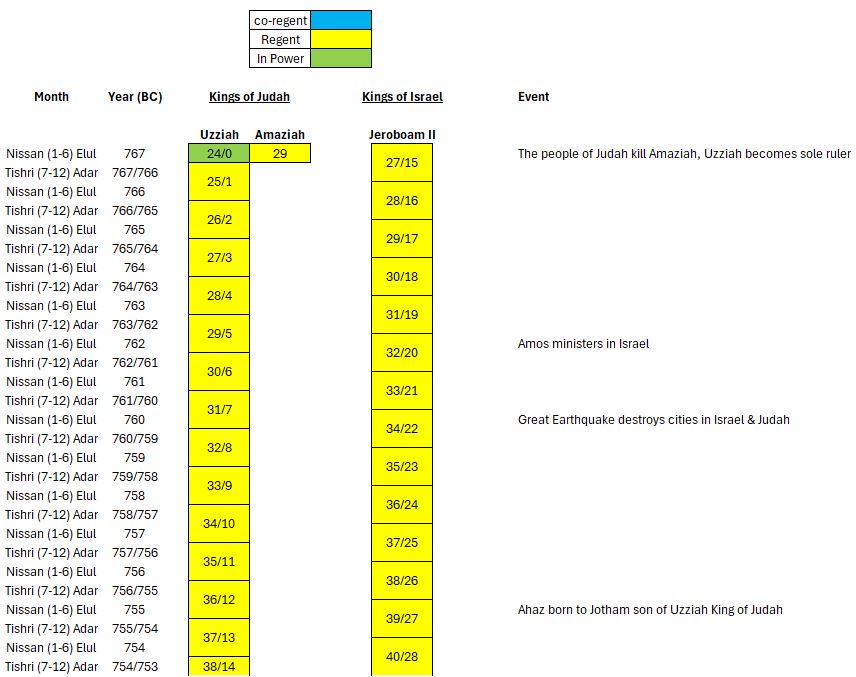
The Renaissance of Judah & Corruption of Israel (767-753BC)
Ref: 2 Kings 15:1-7, 2 Chronicles 26, Amos 1-9
Following the death of Amaziah, Uzziah like his father reorganised the military and sought to strengthen Judah. He embarked on rebuilding the walls of Jerusalem that had been torn down by Jehoash king of Israel, and in the process, he constructed towers and made the defences stronger. Moreover he amassed a great army and a great number of weapons. He also invested in new technologies having siege engines and war machines constructed. Uzziah was faithful to the LORD and sought him throughout the ministry of Zechariah the seer. The LORD gave him victory over his enemies and prospered him in all that he did.
Now Judah had retained control over the Philistine city of Gath before it was then conquered by Hazael. With the Syrian decline and Israelite resurgence, the Philistines rebuilt and occupied Gath. Uzziah proceeded to made war on the Philistines attacking the cities of Gath, Jabneh and Ashdod. He broke down their walls and made them pay tribute. Subduing the Philistines in the West he also extended his kingdom southwards defeating the Arabs of Gur Baal and the Meunites. Now Edom had been brought low in the days of his father, but under Uzziah Judah took control of the lands all the way down to the Red Sea. He built the city of Elath and restoring it to Judah. Now in all these regions Uzziah built towers and fortifications securing his kingdom. During his reign the Ammonites also brought tribute further extending his influence. Under Uzziah Judah reached its greatest height since the days of Rehoboam. Moreover Uzziah invested greatly in agricultural projects as well as military campaigns. In his reign Judah would experience great peace and prosperity.
The Corruption of Israel
In 762 the LORD called Amos who was a shepherd in Tekoa in Judah to be a prophet to Israel. Israel had become a place of idolatry and corruption with the major victims being the poor of the land. Baal may have in theory been cut off from the land, but idolatry was still rife throughout Jehu’s dynasty. Though YaHVeH was worshipped, this was a corrupted distortion of the God of Abraham, Isaac and Jacob. The altars of Bethel and Dan with their golden images, and several other shrines throughout Israel, were part of the national worship. Priests not from the tribe of Levi operated at these shrines throughout the countryside and it was common to have shrine prostitutes. Such was the depravity that both father and son would go into the same prostitute. These people would get drunk at the places of worship, with the wine they had taken from their victims, whilst lying down on the clothes of the poor which they had taken as collateral (Amos 2:6-8). Though Sabbaths, new moons feasts and assemblies were all observed, these were all empty rituals. The people complained wanting to get the holy days out the way that they might continue with their sinful practises of cheating, stealing and oppressing (Amos 5:21-23, 8:4-6). Moreover the leaders perverted justice by taking bribes and afflicting the righteous. They turned away the needy and those who had legitimate causes. Those who confronted this corruption, speaking the truth, or bringing rebuke, were publicly despised. As a result, many kept silent to avoid getting into trouble (Amos 5:10-13).
Though many had become wealthy during Jeroboam’s reign this was often at the expense of the weak and the poor. With the constant wars with Syria much of the population which was agricultural had been impoverished. The wealthy who had benefitted from Jeroboam’s military success and trade, then stepped in to offer exorbitant loans. To pay off debts they could never service, the poor had no choice but to sell themselves into slavery, with the wealthy then seizing their lands. Those who owed even the smallest of debts, amounting to as little as a pair of sandals, were forced into slavery (Amos 2:6, 8:6). Under Jeroboam’s reign the people were abused and afflicted, with the wealthy extracting taxes of grain from them. With the proceeds they had built great houses of hewn stone and of ivory. Such was their lavish wealth, they were able to build both summer and winter houses, whilst planting pleasant vineyards (3:15, 5:11). The crimes weren’t limited to the wealthy men. Their wives oppressed the poor and crushed the needy whilst getting drunk on wine. They were selfish, living in luxury and being cruel, and uncaring, towards their servants, and even their own husbands (Amos 4:1). In the marketplace merchants used false scales reducing the actual quantities sold whilst charging more for less. Additionally they sold known faulty goods trying to palm off the chaff as if it was wheat (Amos 8:5-6).
The Ministry of Amos
Into this setting Amos entered Israel proclaiming God’s anger and pronouncing his judgement. The house of Jeroboam would fall by the sword, the Kingdom of Israel would be destroyed, and the people would go into exile to be scattered among the nations. Yet in all of this there was the call to return to the LORD.
During his ministry Amos had a confrontation with Amaziah the priest of Bethel. Amaziah had heard the words of Amos and reported them to King Jeroboam of Israel. Amaziah accused Amos of sedition and blasphemy. He told Amos to flee back to Judah and never again speak against the king and Israel’s places of worship. To this Amos pronounced judgement upon him announcing that his wife would be ravished, his children killed by the sword and he himself would be sent into exile and die in a foreign land (Amos 7:10-17). With the completion of his ministry Amos returned to Judah where he would write down his prophecy.
The Great Earthquake
In 760 there was a great earthquake that hit Israel and Judah with the epicentre likely in Lebanon. Many cities across Israel and Judah had buildings and walls destroyed. This included the city of Jerusalem where the inhabitants fled from the disaster. This was such a significant event it was included by the prophet Amos as a timestamp for his message. Moreover it remained in the public conscious being referred to by Zechariah some 240 years later and used as an example in his prophecy (Zechariah 14:15).
In 755 Ahaz son of Jotham and grandson of King Uzziah was born. This further secured the house of David with three generations alive at the same time.