The Demise of Two Dynasties Part 2 (853-841BC)
Ref: 1 Kings 22:51-53, 2 Kings 1-9, 2 Chronicles 19-20
In part 1 we saw how following the deaths of Ahab king of Israel and Jehoshaphat king of Judah, both kingdoms went into a period of decline. Under their respective successors both kingdoms lost territory and became weaker. Israel had faced invasions and in Judah even the city of Jerusalem had been sacked. As we continue the story confusingly both the king of Israel and the king of Judah were called Jehoram.
Syria repeatedly invades Israel
In Israel the king of Syria Ben-Haddad II, had gone on the offensive, sending raiding bands into the territory of Israel. The prophet Elisha through divine insight, warned Jehoram King of Israel when and where this was happening and thus the Syrians were continually frustrated. Ben-Haddad II then sent his army to capture Elisha himself which ended in embarrassment. The troops were eventually captured in Samaria, disarmed and sent back to Syria.
With the raids and skirmishes unsuccessful Ben-Haddad II decided to fully make war upon Israel. Gathering his whole army the King of Syria marched through Israel and besieged Samaria. Due to the length of the siege, there was a great famine in Samaria. This resulted in inflation followed by starvation. So dire was the siege that some of the inhabitants resorted to cannibalism. Now after some time the Syrians heard the noise of a great army. Thinking Israel had hired the Hittites or Egyptians against them, the Syrian army fled, leaving behind their camp with its provisions, and throwing away their possessions as they went. Four lepers who were outside the city gate went into the Syrian camp to surrender, but finding it deserted they returned to the city and declared what they saw. After verifying the circumstances, the inhabitants plundered the tents of the Syrians, and the city was saved from war and starvation.
Jehoram King of Judah judged
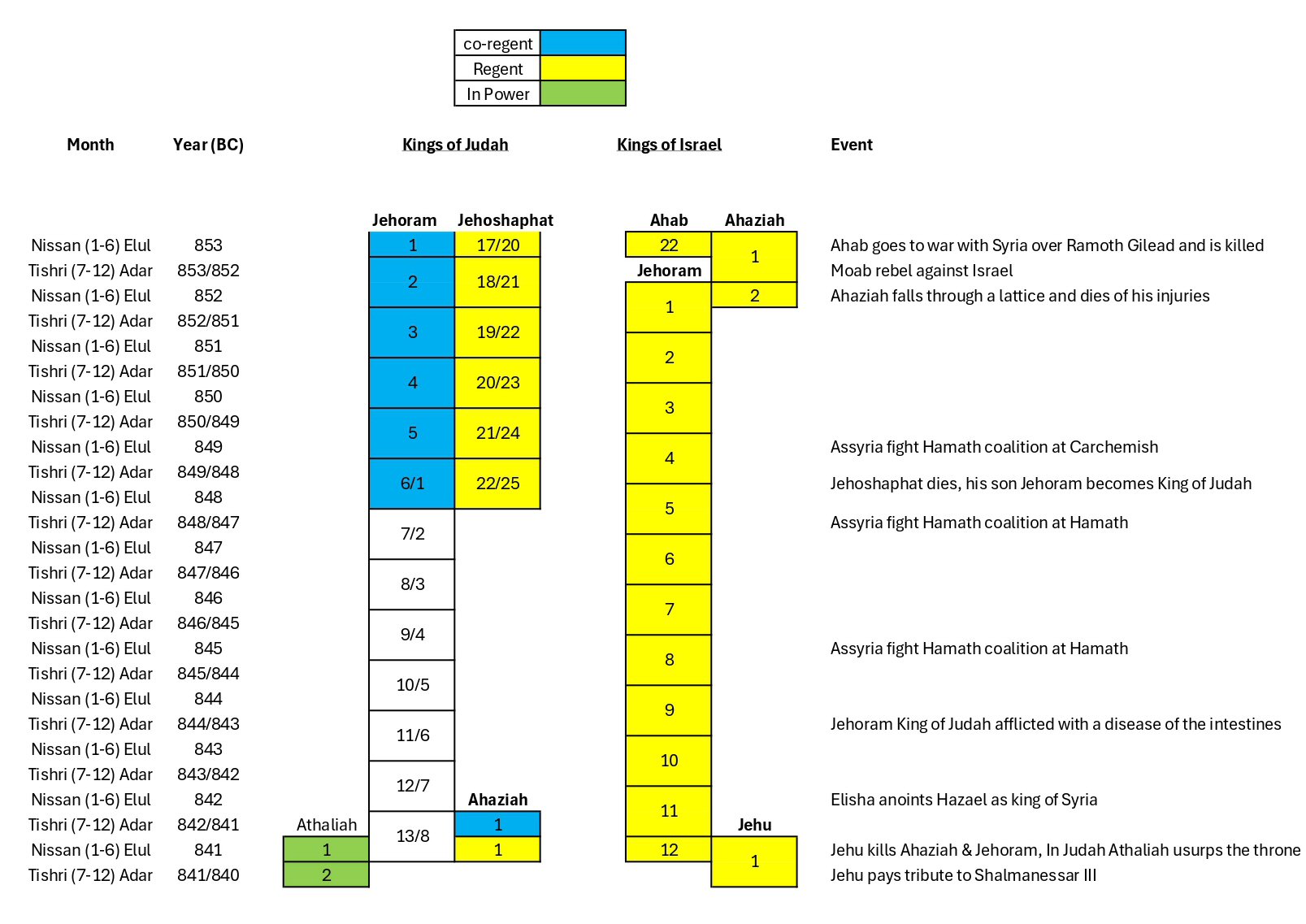
In Judah Jehoram King of Judah continued with building shrines and places of worship to foreign gods, for which he was rebuked by the prophet Elijah. Elijah sent a message declaring that since he had murdered his brothers and led Judah into idolatry, the LORD would strike him with a serious disease of the intestines, until slowly day by day they would come out. In 843 the LORD struck Jehoram’s intestines with an incurable disease.
The Rise of Hazael King of Syria
Around 842 the prophet Elisha was sent to Damascus. When Ben-Hadad II who was sick heard that Elisha was there he sent his servant Hazael to inquire of him whether he would recover. Elisha revealed to Hazael that Ben-Hadad would indeed recover but later began to weep as he knew what Hazael would go on to do to Israel. Hazael relayed the message to his master however the next day Hazael launched a coup. Taking a thick cloth dipped in water Hazael spread it over Ben-Hadad’s face and suffocated him to death. Hazael then seized the throne and proclaimed himself King of Syria.
During this time Jehoram King of Israel seized the opportunity to re-take Ramoth Gilead like his Father had attempted. It seems he was successful. Following the death of Ben-Hadad II it appears the coalition between Hamath and Syria also collapsed. King Irhuleni of Hamath submitted to Assyria becoming a vassal. This left Hazael and Syria as the next target of Assyrian expansion.
In Tishri 842 Jehoram king of Judah knowing he was near death made his son Ahaziah co-regent. Around Nissan 841 after two years of suffering Jehoram’s intestines came out and he died in severe pain. Ahaziah his son then succeeded him became the sole ruler. Meanwhile Israel were again at war with Syria. Hazael had set out to take back Ramoth Gilead from Israel and Jehoram King of Israel was defending it with his army. During the engagement Jehoram King of Israel was wounded and was taken to Jezreel to recover. Hearing about his injuries Ahaziah went to visit his uncle Jehoram and pay his respects.
Jehu ends the Omride Dynasty
At the same time that Jehoram was nursing his injuries, the prophet Elisha sent his servant to Ramoth Gilead, to anoint Jehu as the next king of Israel. The servant came to the Israelite camp and finding Jehu the commander of the army, he poured oil over his head. He declared that the LORD had made him king and that he was to wipe out the house of Ahab. When Jehu’s fellow soldiers understood what had taken place, they pledged themselves to his service. Jehu and his men withdrew from Ramoth Gilead, and riding chariots proceeded to Jezreel, where Jehoram King of Israel was recovering. Jehoram King of Israel and Ahaziah King of Judah came out to meet Jehu in chariots. When they realised what was happening, they attempted to flee. Jehu drew his bow and shot and killed Jehoram. Jehu proceeded to pursue Ahaziah and catching him up by Ibleam they shot him. Ahaziah was fatally wounded and fleeing to Megiddo he died there. Now Jehu had Jezebel the wife of Ahab killed and sending emissaries to Samaria he gave them an ultimatum. They were to send him the heads of Ahab’s sons or to meet him in battle. Seeking to avoid war the elders had 70 sons of Ahab killed and sent the heads to Jehu as instructed.
On his way to Samaria Jehu encountered a delegation from Judah containing 42 brothers of Ahaziah. They had come to greet Jehoram King of Israel and his household not knowing what had taken place. Jehu proceeded to have them king as they were also of the house of Ahab through marriage and descent. Arriving at Samaria Jehu killed any last remnants of the house of Ahab ending the Omride dynasty.
Jehu would go on to destroy the temple of Baal, kill the priests and prophets of Baal and rid Israel from Baal worship which had proliferated through Ahab and Jezebel. The LORD rewarded Jehu declaring that his dynasty would last at least four generations.
Jehu pays tribute to Assyria
Around the same time also in 841BC Shalmaneser III the king of Assyria marched into the Levant and meeting no coalition proceeded to invade Syria. Shalmaneser claims to have killed 16,000 soldiers, with Hazael King of Syria fleeing to Damascus, where he was caged in. After subduing Syria Shalmaneser continued down to Bashan, before crossing the Jordan and journeying across Northern Israel (Jezreel valley) to Tyre. Jehu the new king of Israel went out to meet Shalmaneser who had dealt a great blow against Hazael. Seeking peace and encouraged by Hazael’s defeat, Jehu king of Israel, along with Ba’ali-ra’si (Balezoros son of Ethbaal) King of Tyre, knelt before Shalmaneser and paid tribute.

Shalmaneser would again march into the Levant in his 21-22nd year (838-837) capturing some cities of Hazael but otherwise was unsuccessful. In the process he received tribute from the kingdoms of Tyre, Sidon and Byblos. In contrast Hazael not only held out against Assyria but grew in strength. He would expand his kingdom at the expense of Israel and go on to conquer all the territory east of the Jordan.