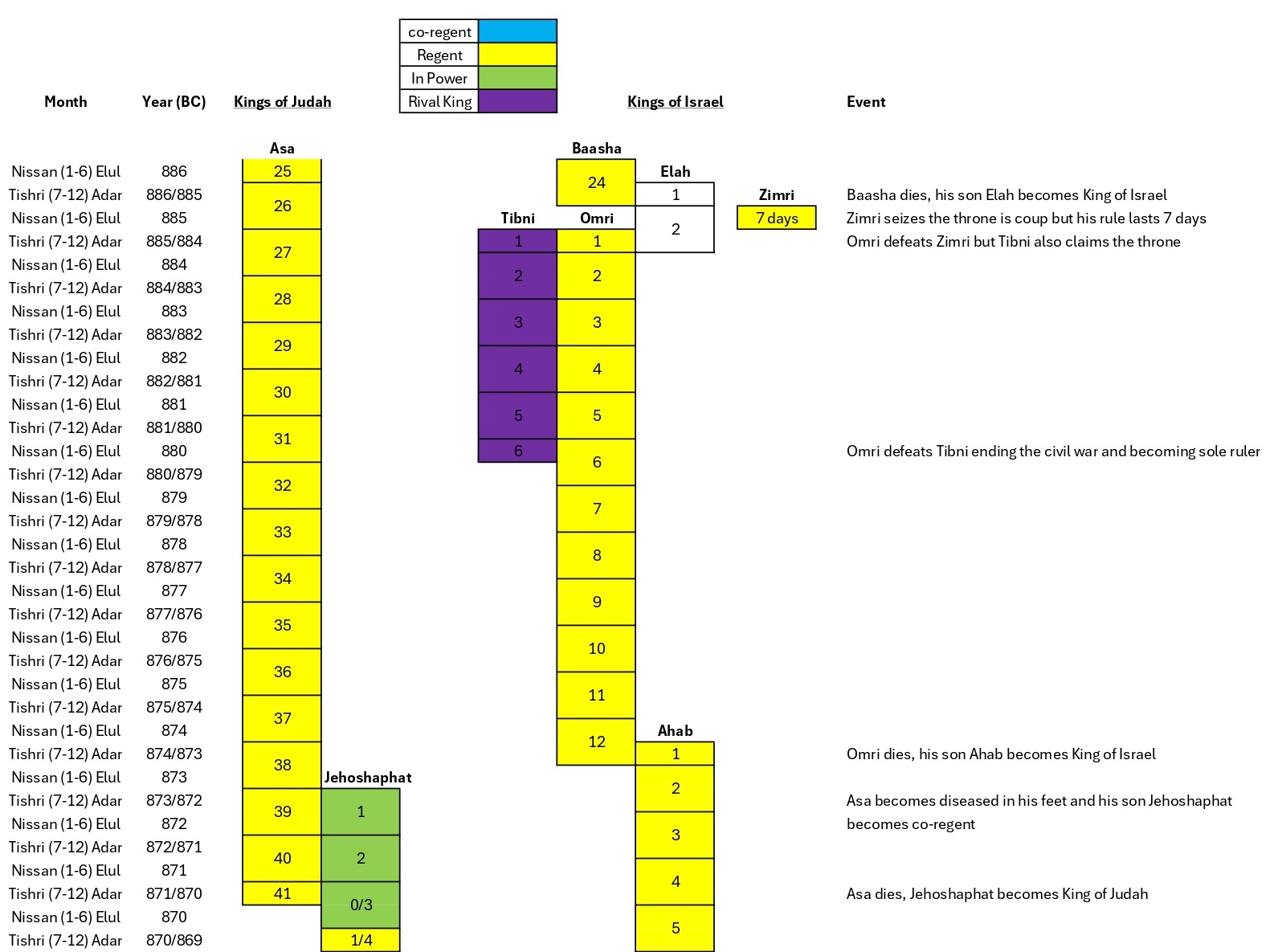
The Rise of the House of Omri (886-870BC)
Ref: 1 Kings 16, 2 Chronicles 16
A Quick Recap
So far since the death of Solomon the Kingdom has been divided into two. The Northern Kingdom consisting of 10 Tribes was known as Israel, with the southern Kingdom of Judah remaining with the House of David and the heirs of Solomon. Since the split both kingdoms had suffered invasion from Egypt and both kingdoms had been at war with each other. Moreover both Israel and Judah had persisted in idolatry being unfaithful to the covenant. Now the first Israelite dynasty of Jeroboam was overthrown with a usurper Baasha taking the throne. Baasha would continue just as Jeroboam before and he too would be overthrown. Judah however remained in the line of David and Asa the great grandson of Solomon was a good king. It was during his reign that he clamped down on idolatry and turned the people of Judah back to the LORD. In the last article we saw how Asa defeated Baasha reducing the power of Israel and bringing an end to the conflict between the two kingdoms. Whereas Judah would become more stable, Israel would descend into increasing instability. It is out of this tumultuous period that we have the rise of the House of Omri.
The End of Baasha's Dynasty
Now about 886BC Baasha King of Israel died and his son Elah became king. Elah inherited a weakened kingdom and sought to restore Israel’s fortunes. As Nadab before him he made war against the Philistines with his army encamping against them at Gibbethon around 884BC. Elah’s error however was that he did not personally lead the army but entrusted it to his commanders. Elah remained in the capital city of Tirzah and whilst there feasted and got himself drunk. There was a man named Zimri who was a commander over half of the chariot force of Israel. He sought to overthrow Elah and set himself in his stead. One day when Elah was getting drunk in the house of his steward Arza, Zimri seized his opportunity. Zimri went into his master and struck him down. With Elah dead Zimri set himself up as king of Israel. He immediately proceeded to kill all the members of Baasha’s house to eliminate any rivals.
Israel descends into Civil War
Though Zimri had successfully seized the throne he didn’t have the support of the army. Upon hearing the news of the death of Elah, the army at Gibbethon made their commander Omri king. Omri proceed to lead the army to Tirzah in order to take the capital. After a mere 7 day reign Zimri saw that the city was taken. He then went into the king’s house and committed suicide by burning down the palace with himself inside. Omri had secured the capital and preceded to set himself up as king of Israel. Though Onri had arguably avenged the death of Elah he like the traitor Zimri had set himself up as ruler by force. Consequently his rule wasn’t universally accepted and the nation was divided. Half of the people elected Tibni son of Ginath as king and the other half followed Omri. This resulted in around 5 years of civil war (884-880BC). Meanwhile in Judah Jehoram the son of Jehoshaphat and grandson of Asa King of Judah was born in 882BC securing the line of David for another generation.
Omri Builds Samaria
Israel had faced external conflict for best part of 50 years and was now enduring a civil war. Omri though was an effectively military commander and a strong ruler. After 5 years of fighting Omri succeeded in defeating Tibni in 880BC. With the death of his rival Omri was now the sole ruler over Israel. Omri began consolidating his power and one of his chief projects was the building of a new capital. Since the death of Zimri Omri had reigned from Tirzah the royal city. The issue however was Omri had to conquer the city and Zimri had burned down the king’s house. On the one hand Tirzah would have required a fair amount of rebuilding and on the other hand Omri wanted to make a clean break with the previous dynasties. Omri therefore bought the hill of Shemer where he established his new capital of Samaria. In his seventh year Omri moved into his new capital where he would reign 6 years from 879BC until his death. Samaria would remain the capital of Israel for 156 years until its fall in 723BC.

Omri Establishes his Dynasty
Following years of instability and civil war Omri recognised the need to strengthen Israel and to assert himself as the ruler. He was a skilled military commander but also recognised the need for diplomacy. He therefore went about strengthening Israel through treaties and military conquest. The civil war had temporarily weakened Israel with its neighbours taking advantage. Moab who had formerly paid tribute seemed to have stopped. Omri proceeded to invade Moab and was successful in annexing their northern territory. With overlordship of Moab he proceeded to oppress the Moabites and extract regular tribute from them. In contrast to Moab Syria were more successful with their dealing with Israel. Taking advantage of the instability, it appears Ben-Hadad the King of Syria had invaded the area of Bashan. He captured certain cities including Rammoth Gilead. This conflict ended with a treaty between Omri and Ben-Hadad. Omri sued for peace and granted trade rights to Syria in order to secure the Northeastern border (1 Kings 20:34). Another peace treaty was made with Israel’s Northwestern neighbour Tyre. Omri entered into an alliance with Ethbaal King of Tyre with Omri’s son Ahab marrying Ethbaal’s daughter Jezebel. By Nissan 873BC Omri had died having reigned 12 years over Israel. Omri through his military prowess had managed to restore the fortunes of Israel. Israel was once again a powerful force and Omri had managed to secure his borders through a combination of military prowess and diplomatic treaties. For all his political success however Omri was judged a failure as he did evil in the eyes of the LORD. Omri didn’t merely follow in the sins of his predecessors, but we are told that he did worse than all before him. His dynasty though was established and would last for three generations. So effective was it that the Assyrians would later consider the House of Omri as synonymous with Israel even after Israel was no longer ruled by Omri’s descendants. With Omri’s death he was succeeded by his infamous son Ahab as king of Israel.
The Death of Asa King of Judah
Though Asa had started well he ended badly and in his latter years he oppressed some of the people. In his 39th year (872/871) Asa became severely diseased in his feet which made him unable to effectively rule. As a result his son Jehoshaphat became co-regent and took over the day to day running of the kingdom. We’re told in Chronicles that Asa refused to seek the LORD and would only consult with his physicians who were unable to help him. Jehoshaphat ruled the kingdom on behalf of his father and within a couple of years Asa died sometime after Tishri 871 and before Nissan 870BC. Asa died in his 41st year making him at this point the longest ever ruler over Israel or Judah.