The Fall of Jerusalem 70AD
The book of Hebrews was likely written around 63AD when the Temple in Jerusalem was still standing. Hebrews argues that the once and for all sacrifice of the Messiah has superseded the sacrificial system of the Old Testament. In establishing a new covenant Jesus has made the old one obsolete; and what is becoming obsolete and growing old is ready to pass away (Hebrews 8:13). Now when Christ died the curtain of the temple was torn in two signifying the way into God’s presence was now open. In spite of this the Jews continued to offer the Old Testament sacrifices however as Hebrews prophesied these were no longer needed and would not endure. It was in 70AD that the city of Jerusalem fell to the Romans and the temple was destroyed. With the temple no more, the authority of the Priests and the Sadducees came to an end. Moreover with the temple destroyed, it was no longer possible to continue with the sacrifices commanded under the Old Covenant by Moses. This brought an end to the High Priesthood and to Second Temple Judaism. From this point Judaism had to reinvent itself to function without the Sacrificial System. Judaism therefore had to morph into Rabbinical Judaism which has continued to this day. With all this said, how did we get to the fall of Jerusalem and the destruction of the Temple?
A Very Quick History
The Old Testament ends with Jews having returned to Jerusalem from Babylon and rebuilding the Temple. The Second Temple was completed in the year 516BC. At this point the Jews were back in their land, but they were a province under Persian Rule. Fast forward to 332BC (when Alexander the Great conquered the Levant) and Judea was now under Greek Rule. However under the Maccabean Revolt, the Jews managed to fight off the Greeks and went on to establish themselves as an independent kingdom. In the process of this, a treaty was made with the Roman Republic in 161BC. Initially Rome and Judea were allies but over time the dynamic would shift. By the time of Herod the Great (37-4BC) Judea had been reduced to a vassal kingdom of Rome, with Rome increasingly interfering for their own interests. Now it was under Herod that a massive renovation of the temple was begun whereby it was effectively rebuilt bit by bit. This is why the Temple of Jesus’ day is often referred to has Herod’s Temple.
Following the death of Herod the Romans after a time would assume direct control of areas of Judea and in particular Jerusalem. They first appointed Prefects (6-41AD) and later Procurators (44-70AD) to rule over the people. The Romans worshipped many gods whereas the Jews only worship One. Furthermore the Romans considered the Jews backwards and obstinate. They often antagonised the Jews and dishonoured their beliefs. This amongst a multitude of other factors meant there was a constant tension between Jews and Romans in Judea. And within Jewish society movements such as the Zealots existed. Their aim was to throw off Roman Rule and re-establish an independent Jewish Kingdom. Throughout the time of Roman Rule Judea was a tinderbox waiting to ignite.
The Roman Jewish War (66-70AD)
In 64AD Gessius Florus was appointed by the Emperor Nero as Procurator of Judea. Under his harsh, indifferent and incompetent rule, tensions between the Jews and the Romans were at an all time high. The initial spark of an uprising began in 66AD with certain Greeks offering a sacrifice outside the entrance to a synagogue in Caesarea on the sabbath. This offended the Jews and made the place of worship ritually unclean. As a result violence ensued between Jews and Greeks with the Romans coming down hard upon the Jews. The Jews made petitions to Florus who refused to hear their case and instead had them imprisoned. Shortly afterwards Florus went to Jerusalem and took funds from the Temple treasury supposedly for Caesar. This led to mass protests and civic unrest. Florus cracked down on the population sending in troops who proceeded to slaughter and loot the upper city. Florus also had leading citizens arrested before having them flogged and crucified. What followed was an uprising where Florus was made to flee and the Jews took control of Jerusalem and the region with resistance springing up throughout Israel. In response Gallas the Roman Governor of Syria marched on Jerusalem capturing cities in Galilee and the Judean coast as he went. In September he managed to capture and burn parts of Jerusalem but doubting he had the strength and resources to capture the city he retreated. This retreat proved disastrous. The Jewish forces pursued the Romans and later ambushed them on the pass of Beth-Horon where the Romans suffered heavy losses. Gallus managed a retreat but with the successful defeat of a Roman army the Jewish rebellion was in full flow. The Jews would retain Jerusalem for an impressive 4 years before the rebellion would eventually be crushed.
Following Gallas’ failure and subsequent death, Nero appointed Vespasian to lead the war against the Jews. Assembling four legions Vespasian began his Galilean offensive in the summer of 67AD. Over the next year Vespasian would conquer all of northern Judea and was preparing for a siege on Jerusalem. Meanwhile in Rome Nero was facing growing discontent with his rule. With the outbreak of open rebellion, Nero fled Rome and committed suicide on the 9th of June 68D. With Nero dead Galba was then declared emperor. When the news reached Vespasian the Jewish war was subsequently put on hold. In January 69 Galba was murdered by Otho who declared himself emperor. Vitellius a rival claimant then marched on Rome and Otho was defeated. Upon hearing these events Vespasian was then declared Emperor by his troops in July 69. Titus was then entrusted with bringing the war in Judea to a conclusion whilst Vespasian would go onto defeat Vitellius and assume control of the Roman Empire. By winter of 69 Titus resumed his campaign. In the spring he marched on Jerusalem and besieged the city. By the summer of 70AD the Romans had captured the city. The Temple was destroyed, the treasures looted and a multitude of people were either killed or enslaved. The whole of Jerusalem was then completely razed to the ground.
It’s important to note that not all the Jews were involved in the rebellion and not all of them were driven from their land. The Jews continued to live in Israel especially in Galilee in the North as well as places such as Jamnia, however Jews were forbidden from ever living in Jerusalem. Also many Jewish communities continued to live throughout the Roman Empire mostly without issue. But for those who were in Judea or involved in the rebellion their punishment was extreme. Josephus records that 1,000,000 died with around 100,000 taken captive as slaves. many brought back to Roman and paraded through the streets.
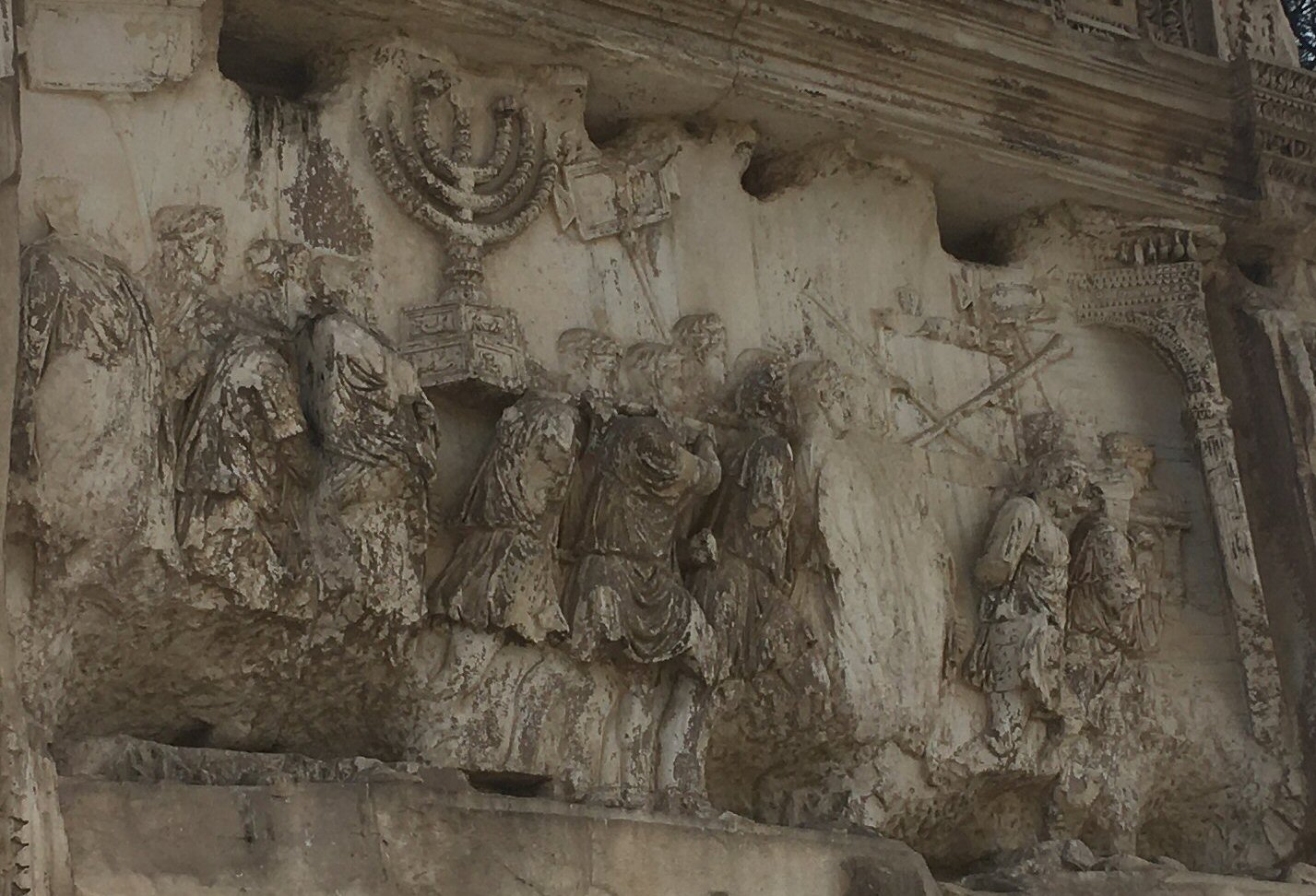
In 71AD Titus was granted a triumph where he was paraded into Rome with the spoils of war displayed. These included the Menorah, Table of Showbread and the Torah Scrolls that had been looted from the temple. Following the loot were many of the captives paraded through the streets of Rome. Later a commemorative arch was erected in the Forum now known as Titus’ Arch. So great was the spoil from the Roman Jewish War that the proceeds were enough to build the Colosseum.