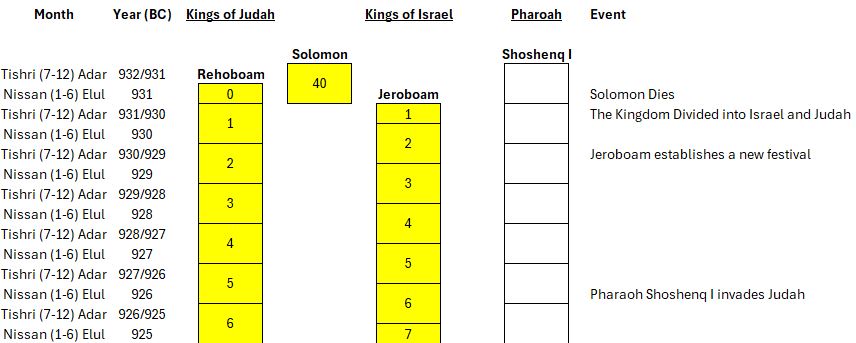
A Divided Kingdom (931-926BC)
Ref: 1 Kings 11-14, 2 Chronicles 10-12
Solomon died in 931BC sometime before the month of Tishri (September). He had reigned 40 years over Israel and taken it to its greatest territorial extent and wealthiest position. Solomon controlled a vast empire stretching from the border of Egypt to the Euphrates River beyond Hamath. Following his death Rehoboam his son became king. In Tishri 931BC all Israel gathered in Shechem to crown him as king and officially acknowledge him as Solomon’s successor. At this time Jeroboam son of Nebat had returned for the occasion. Jeroboam was a former official under Solomon’s regime however Solomon perceiving him to be a threat had sought to kill him. Jeroboam therefore fled to Egypt where he was in political exile. Pharaoh Shoshenq I seeing an opportunity to undermine his powerful neighbour had looked after Jeroboam and now allowed him to return.
Jeroboam acting as a representative for Israel petitioned Rehoboam to lighten the load on the people. Solomon had brought prosperity to Israel but in the process had also introduced conscription and manual labour. As a result the people were weary and heavily burdened. Rehoboam asked them to return in three days whilst he considered their request. Following advice from his young advisors Rehoboam adopted a tough stance not wanting to be perceived as weaker than his father. When Jeroboam and the people returned Rehoboam gave them his answer. He famously said “My little finger is thicker than my father’s waist! My father but a heavy burden on you but I will add to it. He beat you with whips I will chastise you with scourges”. This resulted in the people rejecting Rehoboam as king and they departed from him.
Shortly after Rehoboam’s administration attempted to collect taxes from the people. He sent Adoram who was in charge of forced labour under Solomon (1 Kings 5:14). The people responded by stoning him to death. By doing this the people had openly rebelled against the king. The people then took Jeroboam and made him king over Israel however the southern territories of Judah and Benjamin stayed loyal to the House of David. Rehoboam mustered his army to restore the kingdom, however upon hearing the word of the LORD through the prophet Shemaiah he stood down.
From this point the kingdoms of Israel and Judah would become distinct entities until their eventual falls. Jeroboam ruled the 10 Northern Tribes and the greater portion of the land with Rehoboam ruling Judah and Benjamin from Jerusalem. In terms of Solomon’s empire it is unclear whether it was at the same extent at the end of his reign as it was during its peak. Israel retained control over Moab and possibly Ammon, but the former kingdoms that were vassals of Solomon likely regained their independence. Judah retained control over Edom and perhaps the Philistines (until the campaign of Shoshenq I).
Jeroboam began his reign by building up Shechem as his capital in the mountains of Ephraim whilst also building Penuel in the Transjordan. These two cities enabled Jeroboam to exercise control over Israel on both sides of the Jordan. Now Jeroboam feared that Israel might one day return to the house of David. This was especially a concern since the Law of Moses required the people to appear before the LORD three times a year at the temple in Jerusalem. Jeroboam therefore decided to have two idols made golden calves which he placed in the North in Dan and in the South in Bethel. These idols were meant to represent the LORD and the two shrines were meant to replace the temple in Jerusalem. He also appointed priests from among the people and established a feast in rivalry to the feasts in Jerusalem. Though many of the people went along with Jeroboam’s religious program many of the Priests and Levites as well as people who had a heart for the LORD migrated to the territory of Judah.
In the second year of Jeroboam’s reign on the 15thday of the eighth month (October 930BC) Jeroboam made an offering on the day of the new feast. He was confronted by a prophet from Judah who performed a sign whereby the altar at Bethel was split in two. Jeroboam sought to have him arrested but stretching forth his hand he found it withered. Jeroboam asked the prophet to intercede for him and the LORD restored his hand. Jeroboam wanted to reward the prophet but he would not receive a gift and departed for Judah. Following these events Jeroboam did not turn from his ways.
Now Rehoboam embarked on a building campaign to strengthen Judah. He built 15 cities and fortified many strongholds filling them with men, weapons and provisions. His numbers were also enlarged with the migration of many priests, Levites and those of Israel alienated by Jeroboam’s regime. However it was after three years that Rehoboam forsook the law of the LORD and Judah continued in the idolatry prevalent at the end of Solomon’s reign.

Shoshenq I Relief identifying the cities he campaigned against
In the spring of 926BC in the 5th year of Rehoboam’s reign, Shoshenq I Pharaoh of Egypt began his campaign in the Levant. He conquered the cities of the Philistines before then capturing many of the fortified cities of Judah. He then turned his attention to Jerusalem but Rehoboam paid heavy tribute in order to ransom the city. Rehoboam took many of treasures of the temple and the palace which Solomon had gathered and gave them to Shoshenq. In doing this he recognised Egypt’s rule over the region whilst sparing his city and maintaining his throne. Shoshenq then turned his attention to Israel. Though he records capturing many cities in truth Jeroboam was a willing vassal of Egypt as it was Shoshenq who effectively put him on the throne. Likely an agreement had been made whereby Jeroboam would acknowledge Egypt’s overlordship and Shoshenq would have been received by Jeroboam and paid tribute. Within only a couple of years of Shoshenq’s campaign the Pharaoh had died and been succeeded by his son Osorkon I. It is unclear the relationship that Israel and Judah had with Egypt from this point. Interestingly however in the first four years of his reign, Osorkon lavished 383 tons of gold and silver to the gods and temples of Egypt. This unprecedented figure is likely out of the treasure of Solomon which his father had taken from Rehoboam during his campaign.